
Applying with AI in 2026: What Actually Works – and Why ChatGPT Alone Isn’t Enough
Are you still writing your job applications yourself, from start to finish, one position at a time?
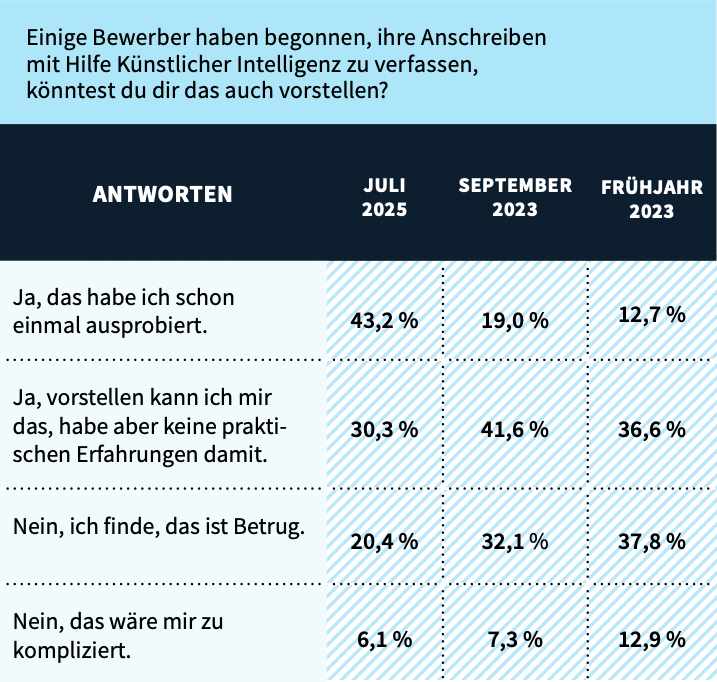
Then you’re in the minority. According to a major study by recruiting software provider softgarden “AI Meets Recruiting” (2025), 43.2% of applicants in Germany now use AI when writing their cover letters. For comparison: in 2023, that number was just 12.7%. In less than two years, it has more than tripled.
And yet, many people still find themselves asking at the end of their job search: why doesn’t any of this work better?
The answer is not whether you use AI, but how. This article explains what research and real-world practice actually show, which mistakes most applicants make, and what an AI-supported job application looks like when it truly makes a difference.
The Current State: AI in the Job Application Market in 2026
The application market has changed drastically in recent years — in both directions.
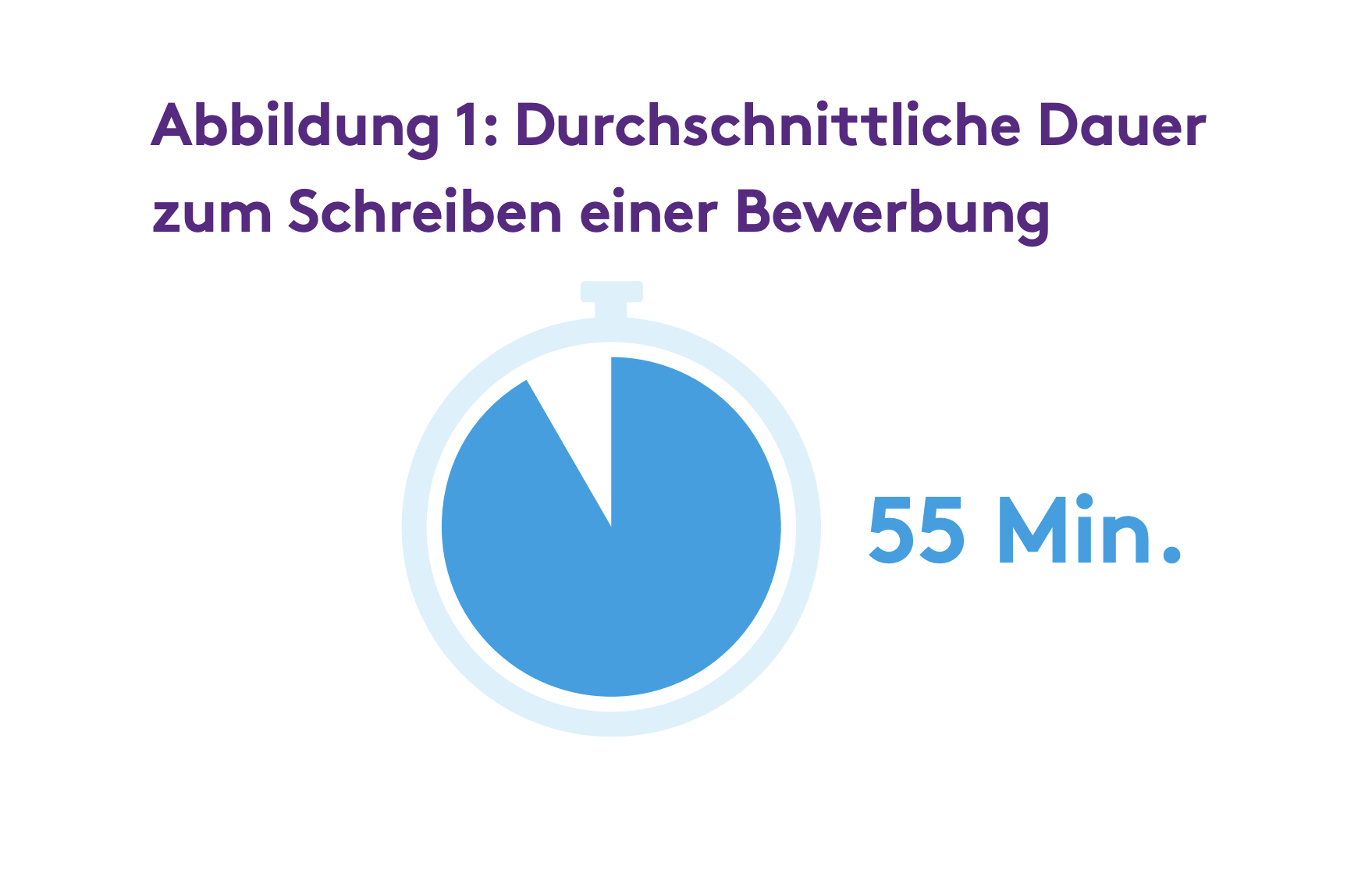
On the one hand, the effort has increased: according to a 2025 Stepstone analysis, anyone looking for a new job today sends out an average of 20 applications before being invited to an interview. Just a few years ago, it was half that. Among university graduates starting their careers, the median is even 40 applications. 20 × 55 minutes (the academically measured time required per application according to a study by the University of Bamberg) — that adds up to more than 18 hours of pure writing work just to land one interview.
On the other hand, the market is paradoxical: despite rising application volumes, many vacancies remain unfilled. In the fourth quarter of 2025, Germany’s IAB (Institute for Employment Research) still counted around 1.26 million open positions in Germany. So the problem is not a lack of jobs — it is a matching problem, and a system that frustrates applicants while leaving positions vacant.
In this context, AI is not a luxury. It is a response to a system that demands more than ever before.
The 43 Percent Question: What Are Most People Doing Wrong?
This is where the real problem lies. The softgarden study shows that among applicants who use AI, 86% rely on ChatGPT as a universal all-purpose tool. They paste in a job ad, summarize their own background in bullet points, and generate a cover letter.
That sounds like a reasonable shortcut. But often, it isn’t.
Why? Because a good application is not a text-generation problem. It is a matching problem. It is about tailoring your experience precisely to a specific role, hitting the right keywords for automated applicant tracking systems (ATS), finding the right tone for the company culture, and keeping all of that consistent across the cover letter, CV, and subject line.
ChatGPT can write text. But it does not know your full CV, it does not have access to the job ad in the right context, it does not know which ATS keywords matter in that industry, and it has no memory from one application to the next. If you use it as nothing more than a text generator, you may get respectable prose — and still get rejected.
That’s not malicious. It’s simply the wrong tool for the job.
What the Research Actually Shows: +8% More Hires
The best available scientific evidence does not come from Germany, but it is clear. A field experiment by MIT Sloan (NBER Working Paper No. 30886, Wiles, Munyikwa, and Horton, 2023) involving nearly 481,000 job seekers shows:
Those who used algorithmic writing support for their résumé were 8% more likely to be hired — and earned 10% higher hourly wages when hired. Crucially, there was no decline in quality. Employers were just as satisfied with these candidates as they were with candidates hired without AI support.
In addition, the effect was strongest among people whose initial writing quality was weakest. AI as a writing assistant acts as a leveler — it helps those especially who are strong in substance but struggle to express themselves well in writing.
In other words: AI works. But it works when used as intelligent writing support — not as a copy-paste generator that spits out the same standard wording for thirty different jobs.
The ATS Problem: What’s True — and What’s a Myth
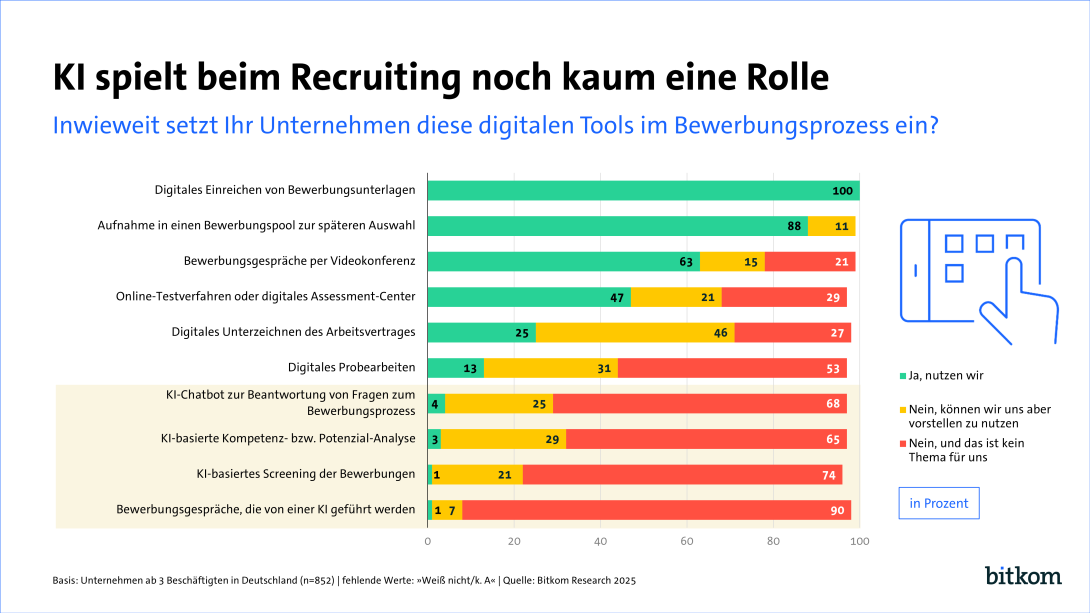
There is one number you keep seeing when you google this topic:
75% of all applications are rejected by applicant tracking systems (ATS) before a human ever reads them.
That number is false — and it has been for a long time. It comes from a marketing document published by a now-bankrupt U.S. company back in 2012, and it was never based on a serious study. Still, it continues to circulate through what feels like every second career guide online.
What is actually true:
Yes, nearly all large companies in Germany use ATS software — SAP SuccessFactors, softgarden, Personio, and Workday are among the most common systems. But these systems do not filter applications autonomously. They structure them, sort them, and make them manageable for recruiters. In the vast majority of cases, the actual selection is still made by humans.
What the data really shows: according to the University of Bamberg study University of Bamberg study, recruiters say they engage intensively with an average of 4 out of 10 applications. That means that even if no algorithm is automatically rejecting applications across the board, they are effectively ignored if the applicant tracking system does not rank them highly enough.
So none of this changes the fact that an ATS-optimized CV matters. Applicant tracking systems parse documents automatically — and anyone using multi-column layouts, text boxes, or unusual formatting risks having their CV imported incorrectly. In that case, it may technically reach the recruiter — but as an unreadable mess of broken text, and then it gets ignored. That is not an algorithmic judgment. It is a technical problem, and one that can be solved.
A well-structured, simply formatted CV with strong keyword relevance is not a gimmick for tech nerds. It is simply a professional standard.
The Three Levers That Actually Make AI Job Applications Better
When AI truly helps in the application process, it does so through these three dimensions:
1. Context Precision Instead of Standard Text
A strong AI-assisted cover letter does not come from a generic prompt. It comes from matching your full profile against the specific job posting — including wording, priorities, and company culture. The more precise that match, the more relevant the result. That is the difference between a cover letter that reads like a template and one that reads like it was written by someone who genuinely understood the role.
2. Consistency Across the Entire Application Process
CV, cover letter, email subject line, HR contact person — these are not isolated documents. A strong application draws a consistent line through every element. If you piece three of them together with different tools and write the fourth yourself, you do not get a coherent overall impression. AI support that covers the entire workflow helps maintain that consistency.
3. Quality Instead of Quantity
Many applicants have the reflex that if the response rate is low, they should simply send more applications. AI makes that temptation even stronger. The result: generic mass applications that do not truly fit any role — and callback rates of under 2%, which automated mass-application tools often achieve in practice.
What actually works is the opposite: fewer applications, but better-targeted ones. Someone who carefully applies to 20 truly relevant roles with personalized, context-sensitive materials has much better chances than someone who sprays 80 generic applications everywhere.
What a Complete AI Application Workflow Looks Like
An honest assessment: most available tools solve only part of the problem. ChatGPT writes text. Canva helps with CV design. LinkedIn shows open positions. But no one handles the process as a whole.
That is exactly where huunt.ai comes in.
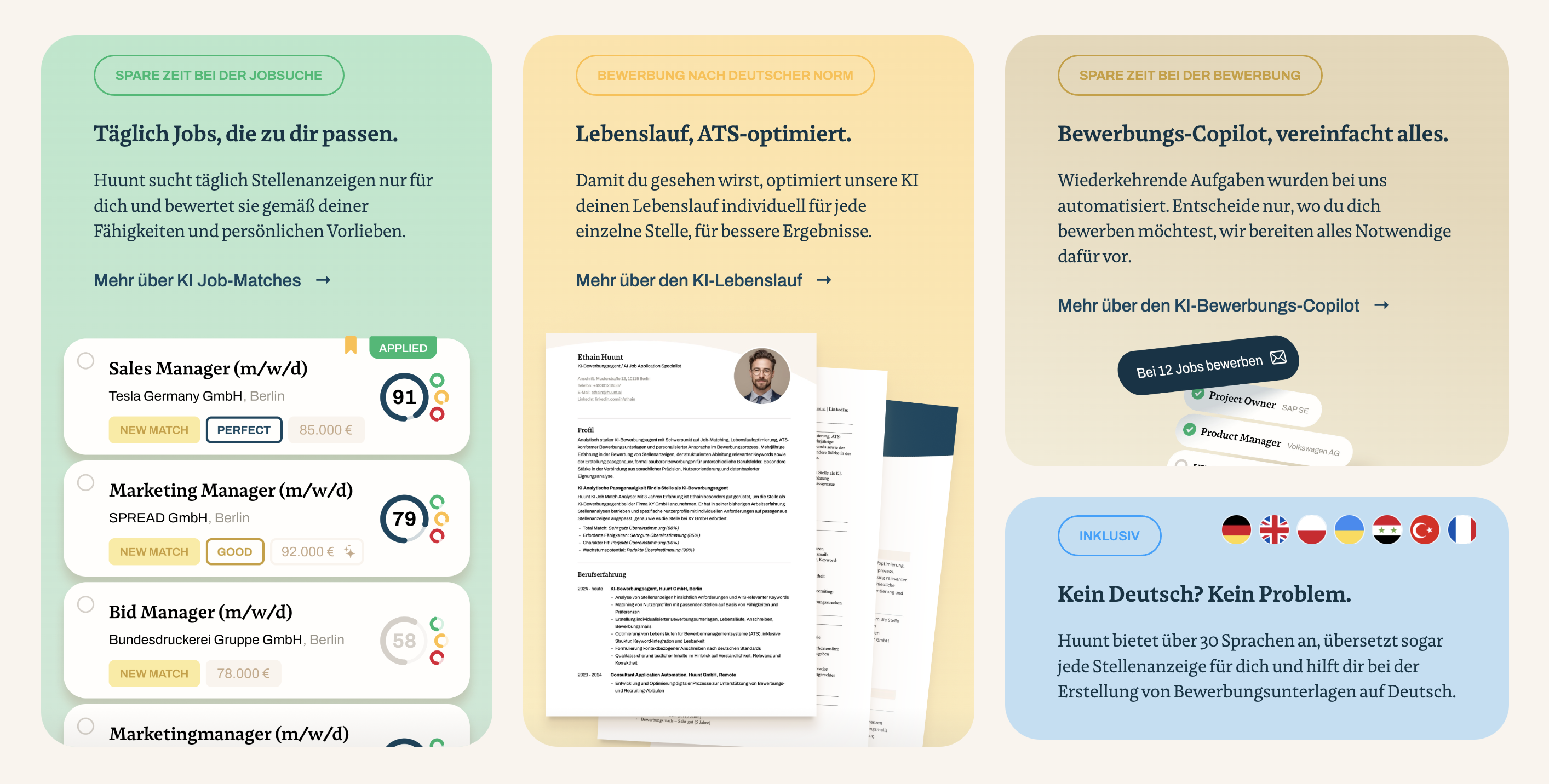
Huunt’s AI assistant Ethain supports the entire application process — from daily automated job search via the AI assistant to the ATS-optimized CV, all the way to the individually tailored cover letter and the ready-to-send application email prepared by the application copilot. No switching between different tools, no manual transfer of information. The application materials are created based on your own profile and the specific job ad — not from templates that could fit a hundred other applicants just as well.
And the final result remains under your control: Huunt prepares everything, while the human decides, reviews, and sends. No black box, no fully automated mass sending.
Anyone who used to spend hours polishing individual cover letters does not just save time with a structured AI workflow. They also gain energy for what really matters: preparing for the interview.
Conclusion: Applying with AI Is Not a Shortcut. It Is Professionalization.
The shift currently taking place is fundamental. Anyone applying today without AI support is not more honest or authentic — they are simply working less efficiently in a market where 43% of the competition is already doing things differently.
But the reverse is equally true: anyone who uses AI the wrong way — as a text generator without context, as a mass-sending automation, as a substitute for genuine engagement with the job — will only produce faster versions of what never worked in the first place.
The question is not “AI or no AI.” The question is: am I using AI in a way that makes my application better — or just faster?
The answer determines whether you end up among the 8% who get hired more often. Or among those still waiting for a response.
Frequently Asked Questions About Applying with AI
Can I use ChatGPT directly for my application?
Yes — with limitations. ChatGPT can write good text, but it does not have structured access to your full CV, no ATS-specific optimization, and no memory across different applications. It is useful as a supplement, but as a complete application workflow, key functions are missing.
Can recruiters recognize AI-generated cover letters?
Generic texts stand out — regardless of whether they were written by AI or by a human. A cover letter tailored specifically to the role convinces — regardless of how it was produced. The MIT/NBER study (2023) shows that employers did not perceive any decline in quality in AI-supported applications.
What is an ATS-optimized CV?
A CV that can be reliably parsed by applicant tracking systems: clear structure, no text boxes or tables, standard fonts, and relevant keywords from the job ad. It does not require specialist knowledge — but it is something many applicants underestimate.
How many applications should I send with AI support?
Not as many as possible. According to Stepstone (2025), the average is 20 applications to reach one interview — that is a matter of fit, not quantity. Someone who applies to 15 relevant jobs with precise, individualized documents gets better results than someone who sends 80 generic applications.
Is using AI for job applications allowed?
Yes. There is no legal or ethical norm that prohibits it. AI is a tool — like spellcheck or professional layout software. What matters is that the content reflects your real experience and is accurate.
What differentiates specialized AI application tools from ChatGPT?
Specialized tools are built around the German application standard: DIN 5008-compliant formats, ATS optimization, structured CV import, and job-specific adaptation throughout the entire application workflow. huunt.ai covers the full chain — from job search to the ready-to-send application email.
Sources: softgarden “AI Meets Recruiting” (2025, n=6,929); Bitkom recruiting survey (2025, n=852); Stepstone “Hiring Efficiency” (2025, n=4,331); IAB Job Vacancy Survey Q4/2025; NBER Working Paper No. 30886, Wiles/Munyikwa/Horton, MIT Sloan (2023, n=480,948); University of Bamberg CHRIS Research Center “The Future of Job Applications” (2017)